Amateur to Pro Milestones · Ages 13–15
The year the tricks stop working
Defenders catch up. The pitch grows. The game stops asking what you HAVE and starts testing what you can APPLY.
The milestones at a glance
- The entry bar — both feet, a full toolbox, a great first touch. At 12 special; at 14 required.
- Application on the big pitch — standing out narrows to 1v1 attacking, 1v1 defending, and fitness.
- Self-drive — the hour AFTER team training, repeated for three years.
- The 70% rule — near-professional fitness just to stay in the conversation.
- The parent's move: less coaching, more architecture — build the support system.
Walk it to the end: a preview of a real Coach Joe assessment session in this bracket — and one action step to run today.
1The new entry bar
What's simply REQUIRED now
None of this is a bonus anymore: shooting with both feet, skills equal on both sides, a large skill set, a great first touch. At 12 these made you special. At 14 they make you eligible. The one-sided player is a passenger — every defender spots the missing foot in five minutes and steers him onto it all game.
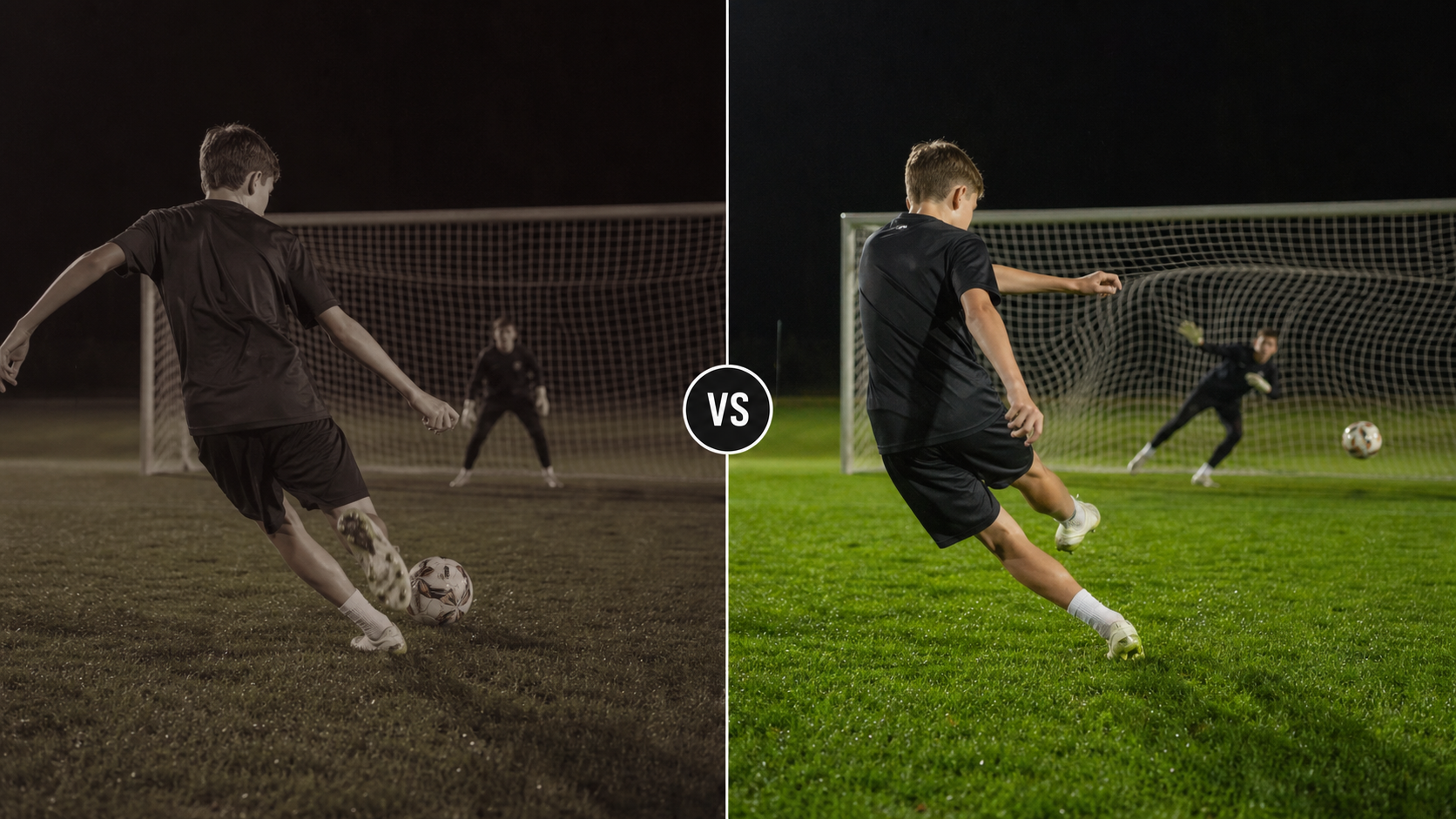
Consistency in the basics under pressure IS the skill now — flair without a first touch is a highlight reel that never happens. And the boring training never stops; what changes at 13 is that it finally becomes APPLICABLE in the real game. Stopping now is quitting piano the week the songs start sounding good.
And even the full toolbox meets a problem it can't solve alone: the pitch got enormous. ↓
2The big-field shock
Why standing out suddenly got harder
The full-size pitch rewrites everything: spatial awareness has to stretch, the small-space runs lead nowhere, and the youth flicks that lived off slow defenders quietly die. Having a move and landing it against a defender who's read it before are different sports.
This is the bracket where lifelong standouts quietly become average — the same simple techniques bounce off good defenders, so they try less and less. The ones who keep standing out learned the REAL techniques, because from here standing out narrows to three things: 1v1 attacking, 1v1 defending, and fitness.
The confusion trap: toward 15, many players simply don't know where they stand anymore — the old certainty stops matching the pitch. An honest assessment at this exact age prevents two wasted years. And training must now be HARDER than the game; comfortable training is a warning sign.
Which is why the real separator of this bracket isn't in the boots at all. ↓
3The engine nobody can install
Who's actually driving the development?
From 13 on, this decides everything: the player has to WANT it. Hunt his own weaknesses, train beyond team sessions — more individual than team-based — and pick work hard enough to fail at. The average player trains what feels good and waits for a coach to develop him. The coach has eighteen other players.
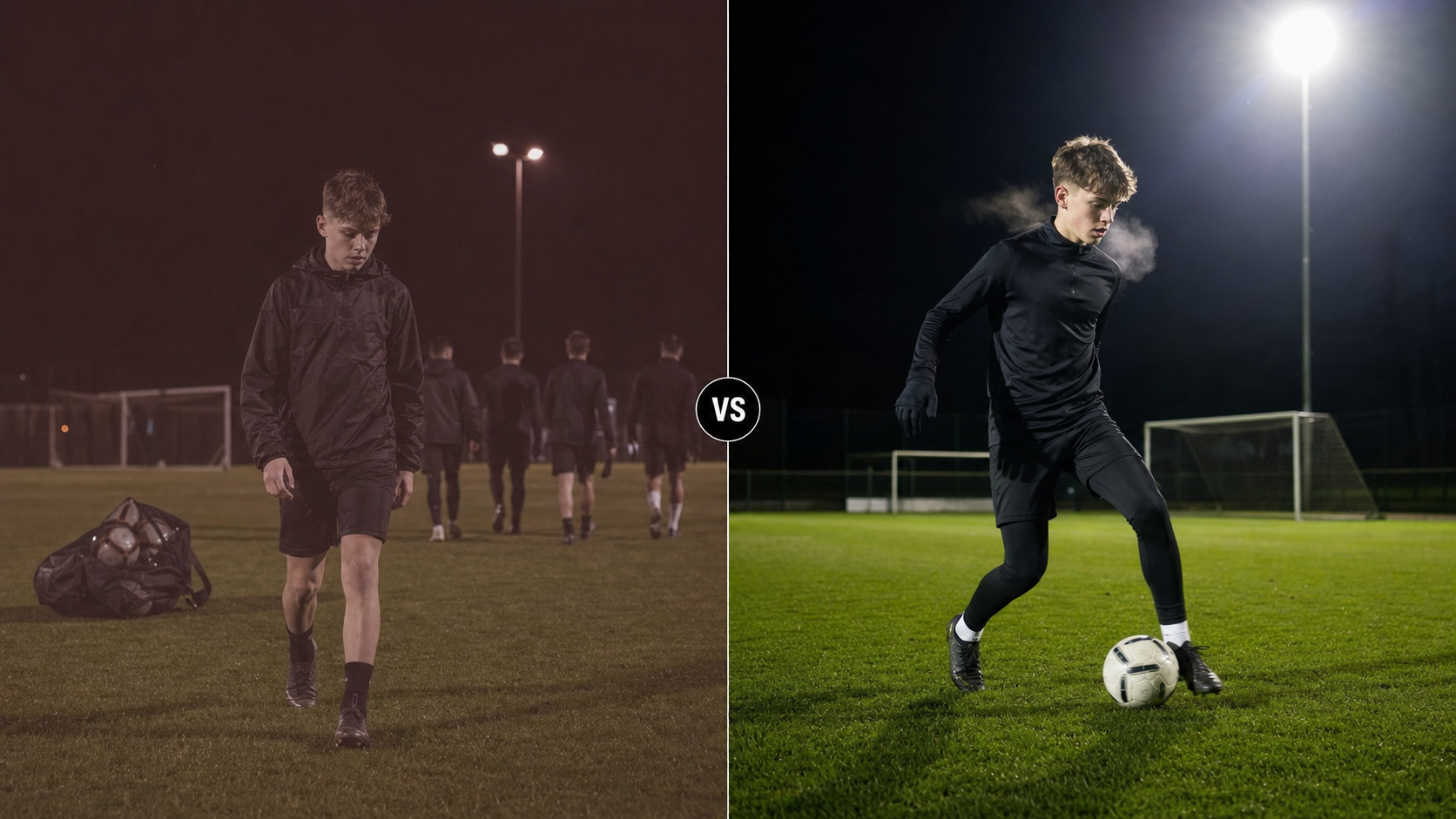
The dressing room changes too: friends become competitors. Same position means his minutes are your bench. The answer isn't paranoia, it's work — the player who improves himself doesn't need anyone else to fail.
The failure ambush arrives right here — and the standouts are the least prepared, because they've never really failed. Failing is not the opposite of progress; it's the evidence of working at your limit. Families who install that sentence early save their player years.
The honest test: what does the player do in the hour AFTER team training ends? That hour, repeated for three years, is the whole difference. Nobody can gift it, buy it, or fake it — and every coach can smell it from the first session.
And self-drive has a physical twin — the number that decides whether any of the skill survives past minute 70. ↓
4The 70% rule
How fit is fit enough now?
Around seventy percent of a professional's fitness level — that's the expectation at 13–15. Not to stand out; just to stay in the conversation. It's physics: the better your technique, the more fitness it takes to keep using it, because a skilled brain in an exhausted body sends signals the legs can't execute.
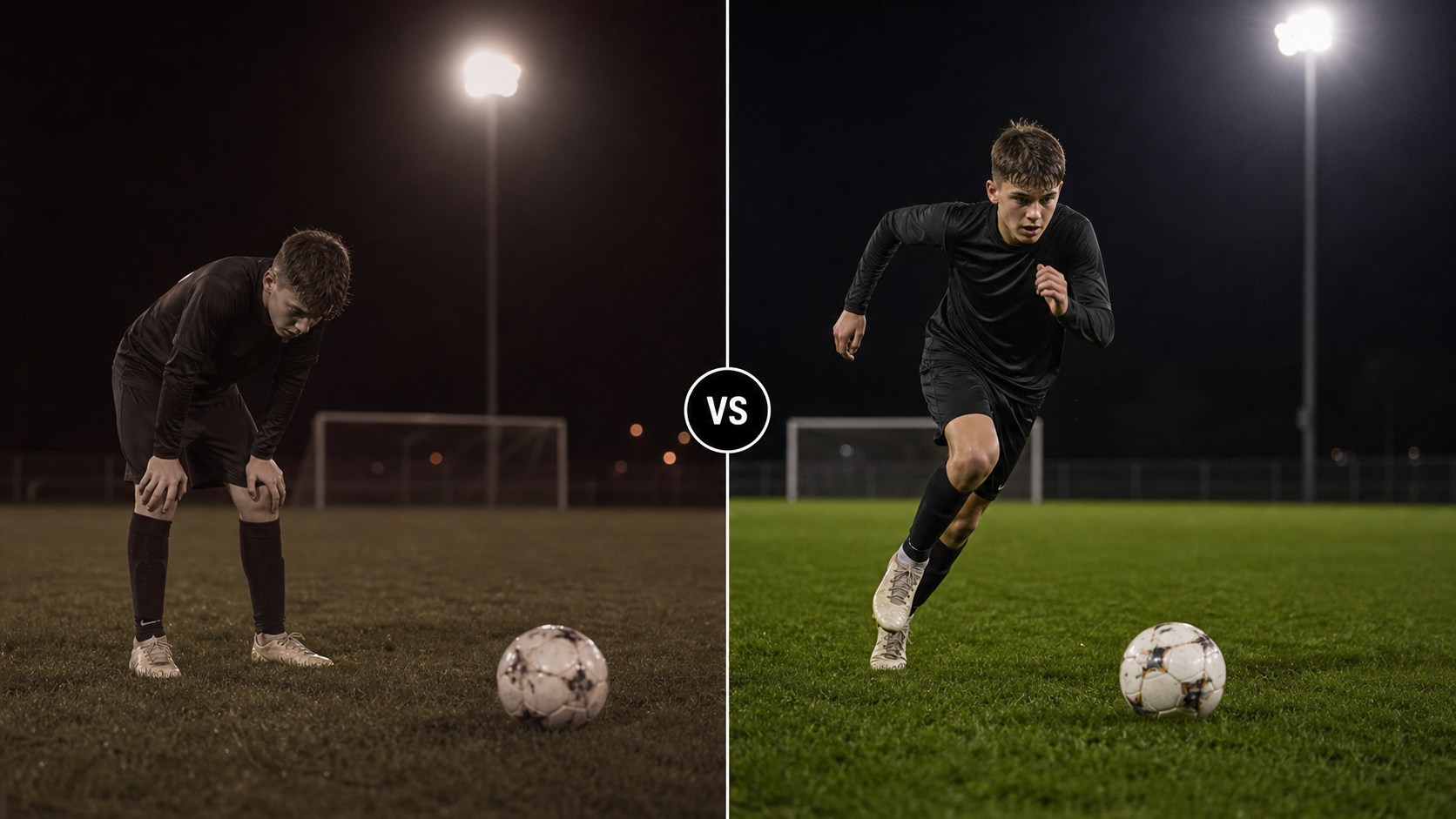
Fading is the first thing every coach sees. The standout's duel in minute 80 looks exactly like his duel in minute 10. Fitness is the guardian of technique — without it, the whole toolbox stays in the bag when it matters most.
And around all four milestones sits the thing that decides whether they get built at all: the environment. ↓
5The support system
What can a parent actually do now?
Less coaching, more architecture. It's not about how much money gets spent — it's about finding the RIGHT people: a proper assessment of where the player really stands, the right individual training, nutrition, recovery, and someone monitoring that it all points the same direction.
The unglamorous jobs: help structure the week (school takes more time now, training has to survive it), hold the accountability, keep one sport the clear priority — and help him RELAX at the right moments. Recovery is training too.
Toolbox, application, engine, tank — now hear how Coach Joe assesses them in a real player. ↓
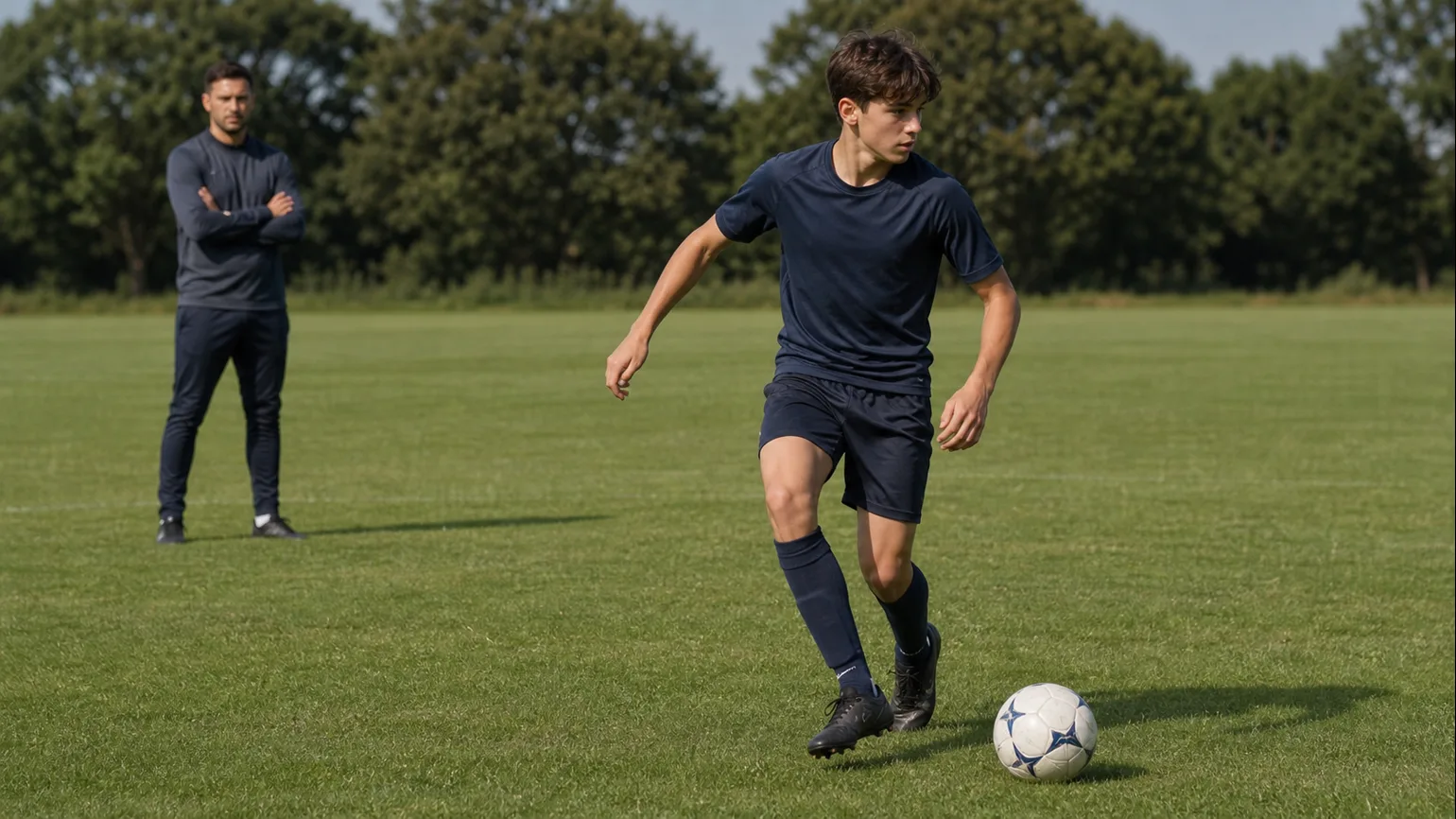
SUGGESTION — they've just read how Coach Joe sees ages 13–15. Short preview of a real assessment session in this bracket — the exact things from this page coached on grass. Pick the strongest assessment clip available.
And here's a ten-minute circuit that tests all four at once — honestly. ↓
Try this today
The both-feet pressure circuit — 10 minutes, one wall, one ball
It attacks three milestones at once: both feet, first touch under pressure, and the standard surviving tired legs.
- 2 minutes: firm passes against the wall, RIGHT foot only. Body half-turned, next action already decided.
- 2 minutes: the same standard, LEFT foot only. No downgrading for the weak side.
- 2 minutes: alternating feet, one-touch. The rhythm exposes whichever foot is bluffing.
- 2 minutes: receive with the back foot, one sharp lateral touch away from an imaginary defender, pass back with the OTHER foot.
- Final round: 20 fast shuttle runs first, THEN repeat step 4 for 2 minutes. The minute-80 test.
Self-check honestly: which foot cracked first — and did the standard drop when the legs got heavy? That answer is next week's training plan.
13–15 is the bridge to the real pipeline: both feet and a full toolbox as the entry fee, application against defenders who've seen it all, self-drive as the engine, and the 70% rule guarding it all. The players who cross aren't the flashiest — they're the ones whose game still works in minute 80.
The Football Parent's Journey by Coach Joe
Everything the football system never tells parents — the car ride home, the coach's buckets, the money map, the exposure playbook — organized by your child's age.
Get startedBeating a Player in a 1vs1
The duel, trained day by day: the 10-day quick-success lane, 30 days of session plans and Coach Joe AI — built from the same sessions pro-pathway players train in.
Get startedDefending a 1vs1 · The Pro First Touch · Speed Control · The Trained Mind · The Tank