The front-third 1v1 attacking transformation · Ages 12–16+

Beating a Player in a 1vs1

The whole map of the duel is on this page — free. What you buy is the training that builds it into your body: day by day, one habit at a time, first visible win inside 10 days.

One-time payment · 7-day money-back guarantee. By Coach Joe — former pro in Europe, 10 years of 1-on-1 coaching, players now in the A-League and New Zealand's 2026 World Cup squad.

On this page

  • The whole map of the duel, free — all seven parts, including the micro-pause and the pro brake.
  • Real session clips of the exact techniques, coached on grass.
  • The proof: two brothers who trained this way and turned professional.

Stay to the end — the last part of the map is the number every player gets wrong about 1v1s.

Be honest for a second

You already know the moves. That's not the problem.

You've done the tutorials. The move works against a cone, against your mate, sometimes in training. Then Saturday comes, a real defender squares up — and you pass it off. Or you try the move, he doesn't buy it, and the ball's gone. So you stop trying, because losing it feels worse than never trying.

Here's what nobody told you: it was never about the move. A 1v1 is a duel with a beginning, a middle and an end — and everything you've ever practiced lives in one small slice of it.

So here's something almost nobody selling you training will do: the whole map of the duel, right now, free. Because the map isn't what changes your game — training it is.

1The map · The duel itself

What a 1v1 actually is

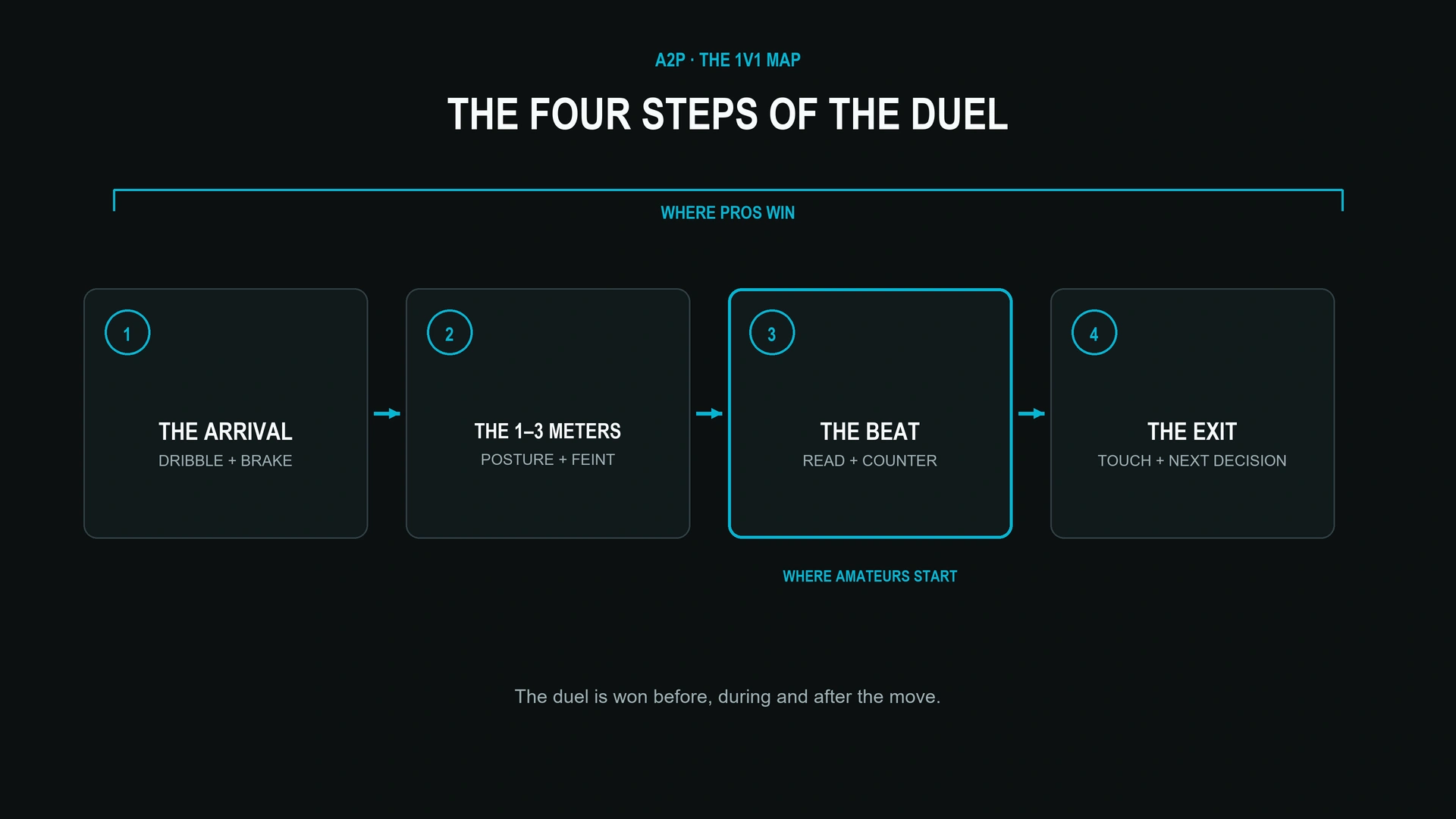
Four steps: the dribble that brings you there, the last 1–3 meters, the beat itself, and what comes after. Amateurs train step three and gamble the rest. Pros win the duel in the other three steps. And the duel changes with the pitch: in your own half it buys space and time, on the wing it pressures the back line — in the front third, you take your man head on, toward the goal.

The four steps of the duel

And the duel is already being decided while you're still meters away — in how you arrive.

2The map · The arrival

How do you dribble INTO a duel?

Braking is a skill almost nobody trains. Pros brake with small, fast steps into the ground, leaning forward, shifting the body toward the defender — arriving low, balanced and loaded. Amateurs do the parachute: leaning fully backwards or stopping in one big step, arriving upright with nothing prepared. If your feints convince nobody, this is usually why — the defender can see you can't actually go anywhere. And the exit out is a skill too: one or two soft touches first, THEN the explosion. Never maximum power on the first touch.

Braking well delivers you into the zone where every duel is truly won or lost.

3The map · The pre-skill space

What happens in the last 1–3 meters?

More is decided in this strip of grass than in any skill move ever invented. It's all body: feet close together, body straight, on your toes, on top of the ball — leaning INTO the defender so the duel is already pushing toward the goal before the move happens. This is where the pre-feint lives: the little lies your body tells while it's perfectly balanced to go either way. Inside the transformation, this zone gets its own sessions — because it's the highest-leverage meters in football.

But balance and feints aimed at nothing are just dancing. You need to know exactly what the man in front of you wants.

4The map · The other side

What is the defender actually thinking?

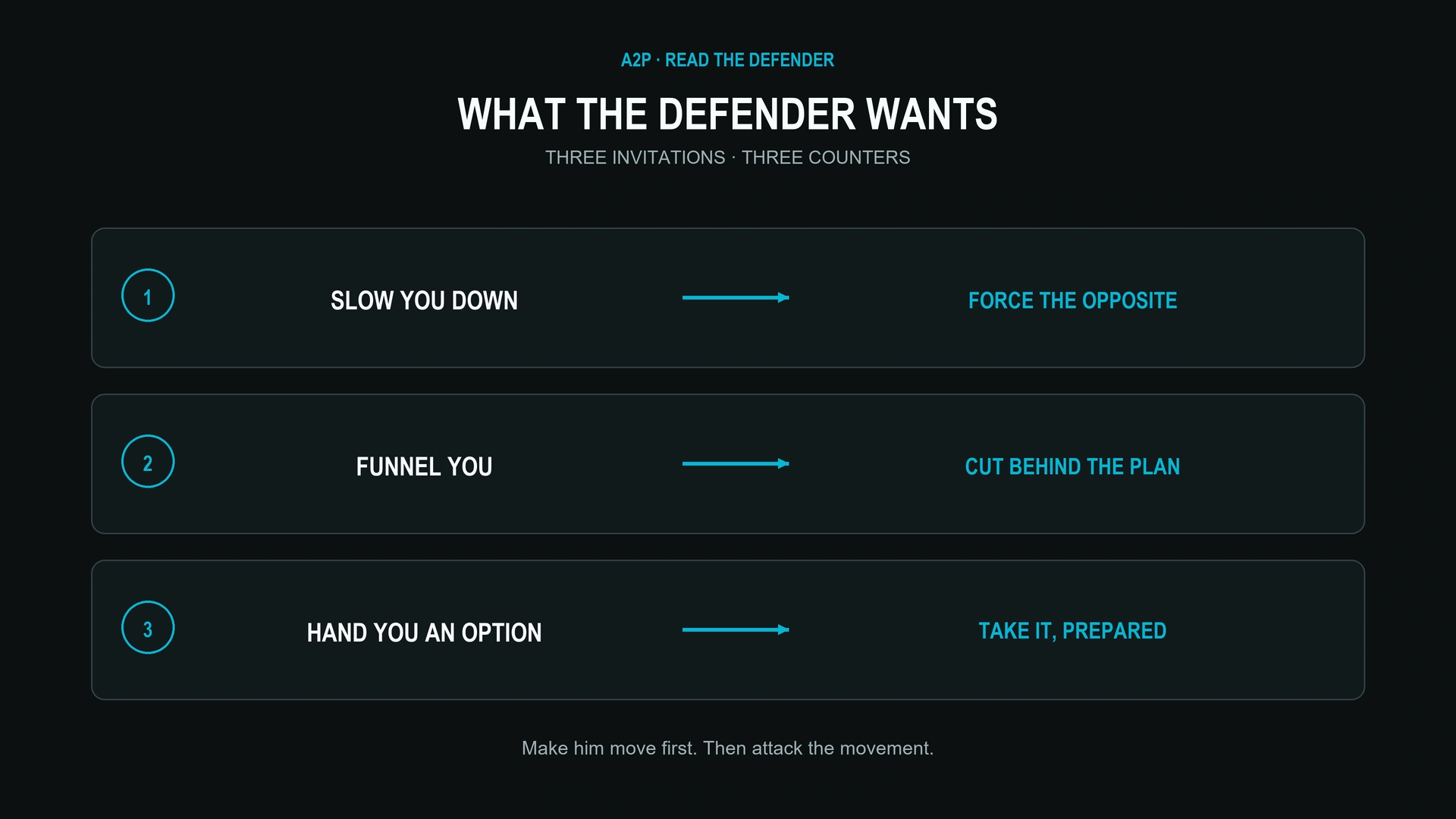
Every defender wants three things: to slow you down, to funnel you, and to hand you an option — the direction HE wants you to take. Both sides of that are exploitable: force the exact opposite and cut into the space behind his plan, or accept his invitation while preparing your move to the other side. And one worry you can delete: the defender almost always closes the angle to the goal — which means the goal sits in a line behind him. Beat the man, and you're facing it.

What the defender wants: the three invitations

Once you know what he wants, you can make him MOVE. And making him move is the entire secret of beating players.

5The map · The beat

How do pros actually get past their man?

In football, reacting is easier than acting. Force your move against a waiting defender and HE reacts to YOU — a good defender wins that almost every time. Pros flip it: their approach forces the defender to move first, then they counter that movement. They hunt exactly three reactions — the lunge, the flat feet or heels, the turned toes — and the instant one appears, the move happens. Not before.

The professional's pause: a microsecond of reading in the last meters. Amateurs run, feint and execute in one committed motion — if the defender guessed right, it's over. That pause is one of the biggest amateur-pro differences in football, and building it into your body under pressure is exactly what the session plans train, rep by rep.

There's also a passive way to win the duel. In tight space, pros slow down on purpose — drift sideways, even slightly backwards — and make themselves look weak. The defender smells it and comes to press. THAT movement is the reaction they wanted: with the right preparation and technique they accelerate past him through the press. The trap only works because the body control underneath it is real.

And yes — you need the library. A real collection of moves off both feet, and the knowledge of which fits which situation. One move with one foot against a defender who's read it isn't a library — it's a habit.

So the defender's behind you. Most players relax right here — and hand the duel back within two seconds.

6The map · After the beat

You’re past him — now what?

The beat isn't the end of the duel — it's the start of the decision. Where you push the exit touch matters as much as the move that freed you: the wrong space hands everything back to the recovering defender. Shot, final pass, or the second defender — the duel you just won tells you which is coming. Beating multiple defenders isn't one move repeated; it's the same read-react cycle run again, faster, in the space you just created.

Which leaves the question that decides whether any of this ever shows up in your games: how often are you even trying?

7The map · The bravery math

How often should you actually win a 1v1?

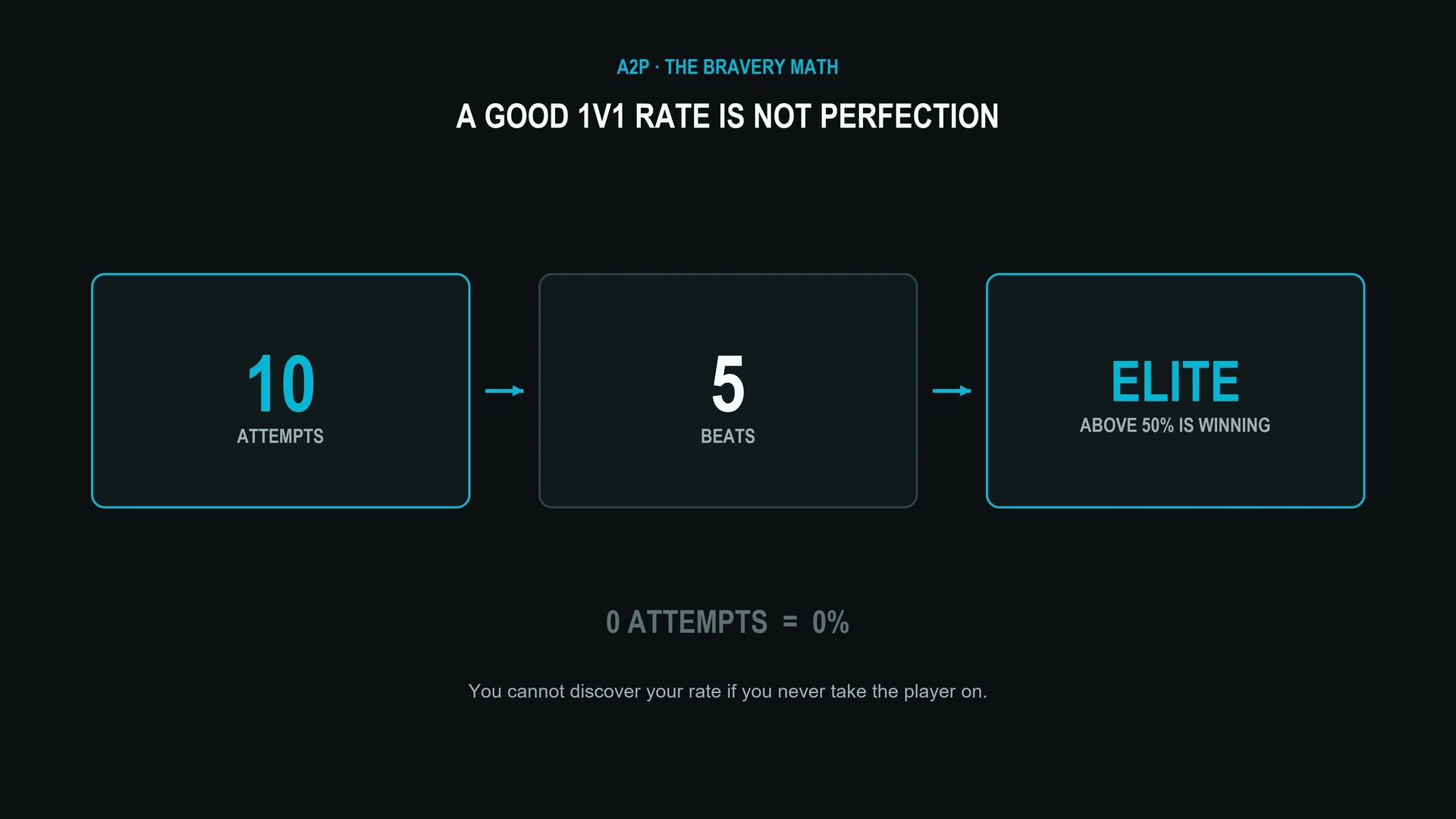
Most players think a good 1v1 success rate is 70–80%. The truth: everything above 50% is good — ten attempts, five beats with a shot or a dangerous ball created is a LOT. Most players never find out their rate, because they pass it off to protect themselves — and the teammate loses it anyway. The front-third rule: one defender between you and the goal? You take him on. Always.

The bravery math

That's the map — the whole duel, free. Now the honest part: a map has never carried anyone up a mountain.

8Why it’s all free

Why give the whole map away?

Reading about the micro-pause doesn't build it into your legs against a real defender at game speed. Reps do — the right reps, in the right order, with the right focus each day. That's the actual product: not information, implementation.

  • The 10-day quick-success lane: day-by-day session plans engineered for a visible win inside ten days — so you feel it working before the habit gets hard.
  • The full 30-day session plans: Eyes, Body, Timing, Recovery — every day planned, one habit at a time, built from the same real sessions pro-pathway players train in.
  • Coach Joe AI: ask your questions between sessions and get answers grounded in Coach Joe's real coaching — not generic internet advice.

And if you're wondering whether this coaching actually takes players anywhere — meet two who started exactly where you are.

9The proof · One family, ten years

Does training the duel like this actually work?

Coach Joe played professionally in Europe. For the last ten years he's done one thing: individual coaching — including over 500 sessions with the two brothers below, one family, who started with him at 13 and 15. Today they're 23 and 25. The 1v1 detail work in this transformation is the same work they trained.

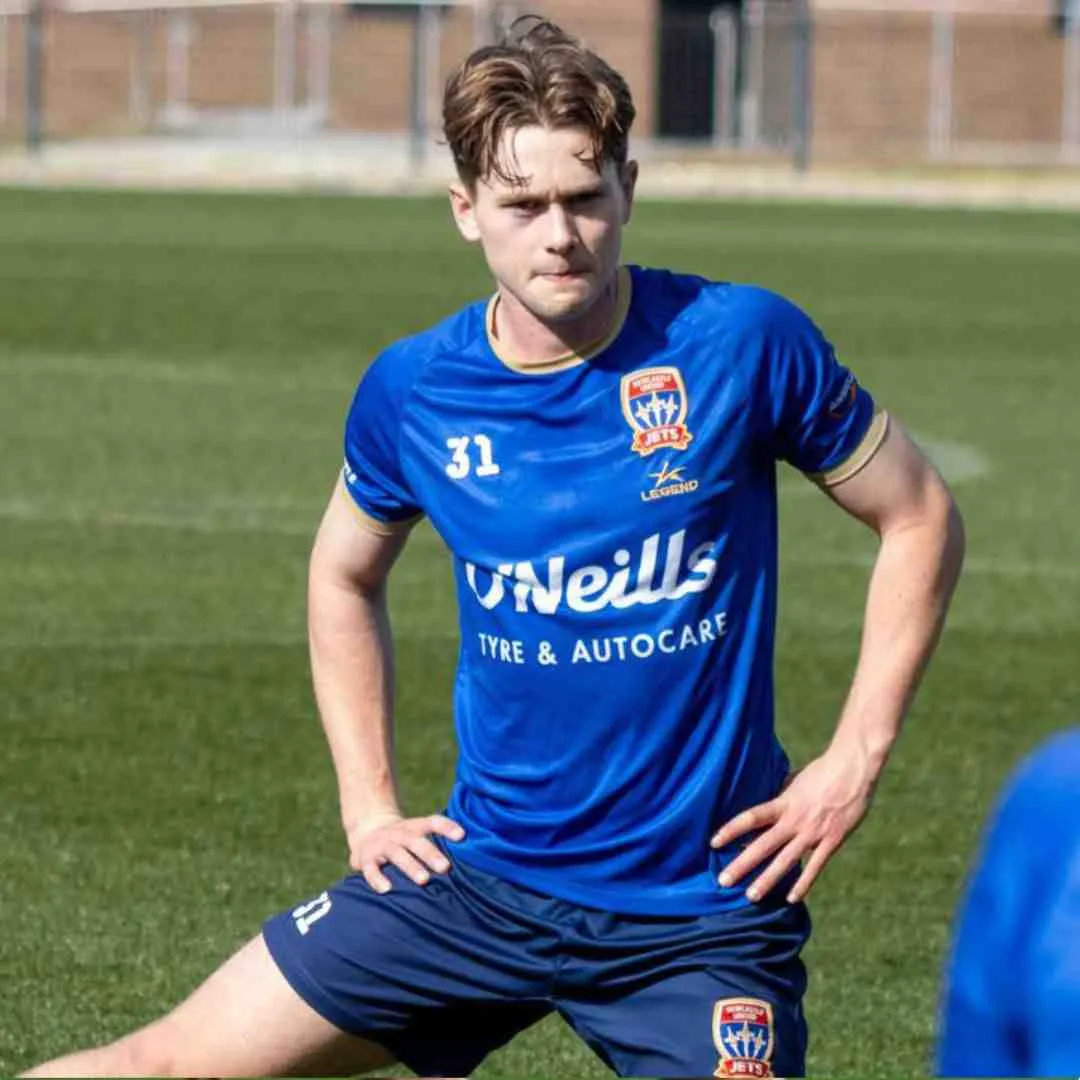
Lachlan Bayliss playing professional football
Lachlan Bayliss13 years old → New Zealand 2026 World Cup squad

Started with Coach Joe over 10 years ago, at 13. Today, at 23: A-League professional, New Zealand international — and named in New Zealand's squad for the 2026 World Cup in America.

James Bayliss playing professional football
James Bayliss15 years old → pro, twice

Started at 15. Now 25. Turned pro, won the A-League Championship with Central Coast Mariners, dropped to semi-pro — and fought back to pro with Auckland FC in the Oceania league. Back up after a downgrade is something most players never do once. He did it twice.

“I like the attention to detail working on weaknesses in our game. I feel like I've most improved my dribbling ability and 1vs1 skills.”

Lachlan Bayliss — Professional Footballer

“What I have most enjoyed… is his attention to detail on the skills and techniques… I have not trained with another coach who has placed this much emphasis on every little touch.”

James Bayliss — Professional Footballer

“I love my sessions with Joe and my game has improved massively… I now love football and I am so focused when I play and much more confident.”

Max — Youth Player

Two brothers started exactly where you are — with the same map you just read. The difference was the training.

One payment. Yours for good.

Beating a Player in a 1vs1 — $279

  • The 10-day quick-success lane — day-by-day session plans for a visible win inside ten days
  • The full 30-day session plans: Eyes, Body, Timing, Recovery — one habit at a time
  • Coach Joe AI included — answers between sessions, grounded in Coach Joe's real coaching
  • Two tracks: 10 minutes a day, or the full-commitment version
  • 7-day money-back guarantee, no questions asked
Get started now — $279

One-time payment · 7-day money-back guarantee. Prefer working with Coach Joe in person? That exists too — $1,497, honestly limited by his calendar.

Every question answered inside

No answers here — the answers live inside. Just so you know exactly what you're getting:

What do my eyes need to find in the defender's first three steps?
How do I train the micro-pause until it fires without thinking?
Which skill variations actually win duels — and which only look good in training videos?
How do I arrive balanced at full speed, every single time?
What do I do in the last three meters against a waiting defender — and against a rusher?
How do I bait a good defender into moving first?
When do I use the passive 1v1 trap — and when never?
How do I keep the ball after the beat with a second defender closing?
How do I train all of it alone, with no defender available?
What does each day of the 10-day quick-success lane look like?
How do I measure that my duel win rate is actually climbing?
How do I use Coach Joe AI between sessions?
A2P 7-day money-back guarantee badge
How is this different from the tutorials I already watch?

Tutorials hand you moves — step three of the duel. This trains the whole duel in order, day by day, one habit per session, with a visible win inside ten days. You don’t collect information; you build the player.

What age is this for?

Built for ambitious players roughly 12–16+. Younger players can train the sessions with a parent guiding them.

What if it doesn't work for me?

Train the first sessions. If inside 7 days you don't see the point, one email gets your money back — and you keep what you learned. The map above is the fair preview.

You now hold the whole map of the duel — free. What's left is the part no page can give you: the reps that build it into your body, planned day by day, the same work a 13-year-old once started and carried into a World Cup squad. The only question left is the one every duel asks: are you going to commit?

Get started now — $279