Beyond the Game — with Coach Joe
The Half-Second That Is Crucial If You Want To Become A Pro
Listen to the episode, or read it below — same lesson, your choice. It comes from one real coaching session where a skilled player kept losing the ball for one reason nobody in the stands could see.

AUDIO PLACEHOLDER — the final episode recording drops in here (upload the episode MP3 to the media library and set it as this player's source). The written version below is complete either way.
If you only remember five things
The five points that matter
- One glance loses the duel. The moment your eyes jump to the defender, the ball goes blurry — and the situation is already decided.
- It's a mental switch, not a skill problem. Under pressure your brain weighs trusting your ability against reacting to the danger — and defaults to the danger.
- Fight-flight is wiring, not weakness. The instinct that pulls you backwards can be overridden and used — the defender runs on the same wiring.
- The gap is automation. Needing to actively focus on something versus your body just doing it — that's one of the biggest differences between amateur and pro level.
- Progress is quiet. Later mistakes, calmer answers. Thirty minutes before the first bad touch — that used to be minute one.
The written episode
Read it like the session happened
One glance is all it takes
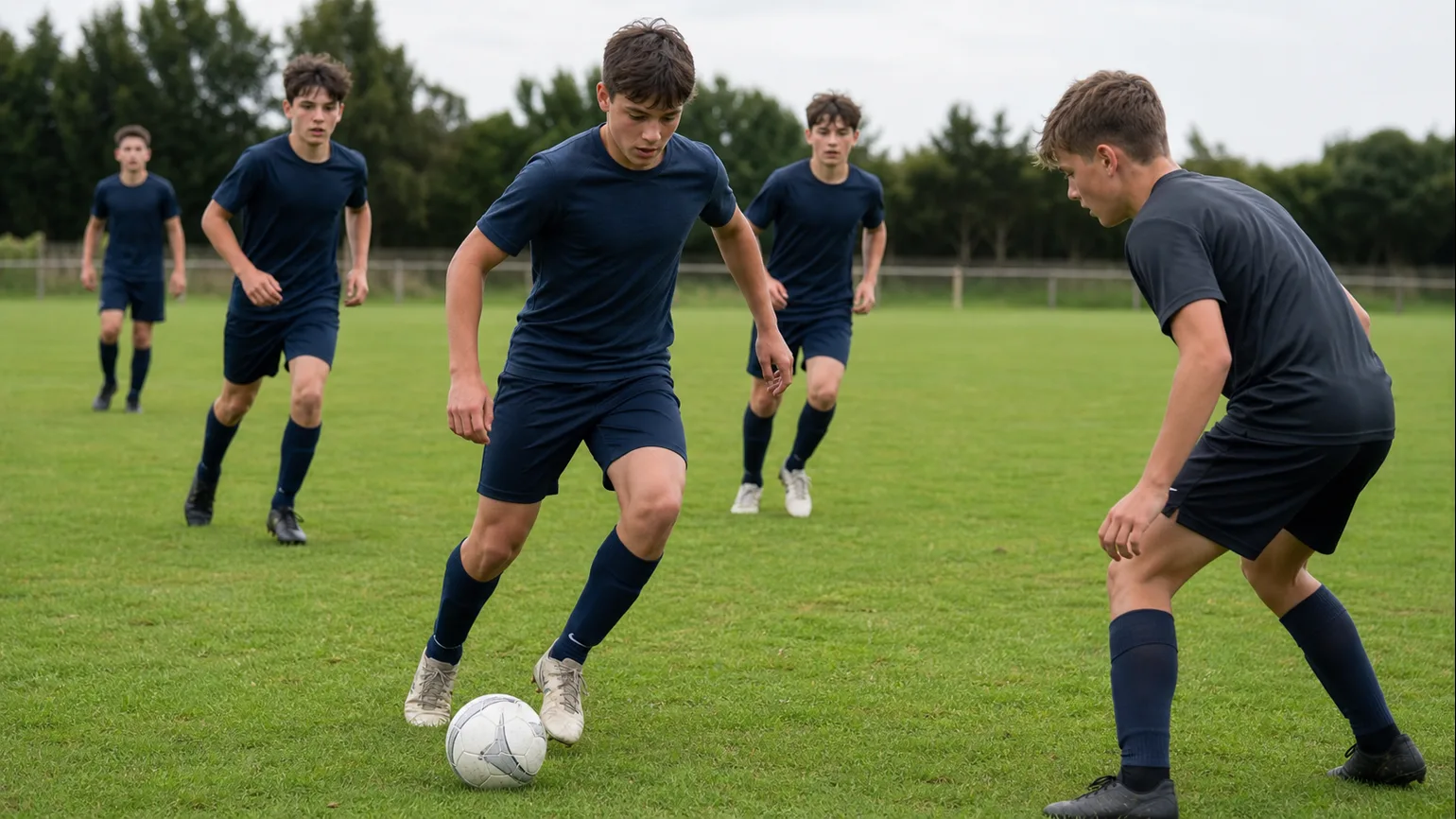
The moment the defender turns from passive to active, the entire situation changes. The player tenses up, goes wide, glances up at the defender — and loses track of the ball. One glance. That's all it takes.
Coach Joe stops everything. Not to fix the touch. To ask a question: why do you think your brain tells you to look at the opponent instead of the ball, right in the moment you can least afford it?
What the brain is really doing
Under pressure, the brain is weighing two things against each other: trusting your abilities to solve the problem, or reacting to the immediate danger of the opponent. The default primal response — for almost every player — is to focus on the opponent. The head comes up. The eyes lock onto the threat. The ball, the one thing that actually needs managing, goes blurry or fully out of the visual.
"Your brain is weighing between trusting your abilities to solve the issue or the pressure of the moment." — Coach Joe, mid-session
Fight-flight — and how pros use it
Once the defender is allowed to fully tackle, the player suddenly retreats a few metres backwards — and Coach Joe points out immediately what actually happened: fight-flight mode. The primal instinct. The same wiring that once kept humans alive is now pulling a footballer away from the exact space he needs to attack.
The pro standard is honest: you don't suppress that instinct, you override it and use it — because the defender is running on the same wiring, and the player who understands the instinct and is able to override it gets to use it to his advantage. That is a pro-level thing that needs to be learned over years.
What it costs at the higher level
A player can be technically excellent for years and still get eaten alive by a defender at the higher level — because at that level, every defender waits for the moment your eyes leave the ball and you lose control. Selection doesn't come down to who has the better skills nearly as often as players think. It comes down to who still has control of their body and can therefore control the situation and the opponent. Every pro coach can see this immediately.
It's trainable — here's what changed
Thirty minutes before the first misplaced touch — that used to happen in minute one. And when a loose ball finally came, the player did something he would never have done months ago: he just let it roll, sprinted onto it and readjusted his body position to regain control. The panic-grab is gone.
That is what reprogramming into a player who can deal with any situation under pressure looks like. One repetition, one correction, another repetition at a time. A feedback practice loop that every pro player is familiar with.
"In the olden times you would have reached for that ball again." — Coach Joe
Pride and the bar, in the same breath
Coach Joe's pride in the player's progress is real — happy and proud of how far he's come, said in exactly those words. And the bar keeps rising, because that's the only way if a player dreams of becoming a professional. It isn't all automated into the subconscious yet. That gap — between needing to actively focus on something, and your body and brain just executing it — is one of the biggest differences between the amateur and the pro level. There's no shortcut through it. There is only the next rep, and the feedback loop.
This week's action
- In one training session, pick a single pressure moment — receiving with a defender closing in, or attacking a player 1v1.
- Give yourself one task: keep the ball in at least sixty percent focus with one eye, and try to read the opponent with the other.
- Self-check afterwards with one question: when it got tight, what did I look at? If the honest answer is "only the defender" — that's your reset cue for the next rep.
Reset cue: ball first, opponent peripherally. Say it before the rep, not during.
Where does your game actually stand?
The players who reach the next level aren't the ones who never feel the panic. They're the ones who went through countless reps and feedback loops. If you want to know where you stand compared to the pro level, start with the free Road to Pro Milestones — one honest answer and action steps to take.